Private label makhana lets you sell makhana under your own brand name without growing, sorting or packing it yourself. A supplier provides the graded product and packing, and you own the brand, the pack design and the customer relationship. For many new founders, that is the fastest and lowest-risk way into a category that keeps growing.
However, a good launch depends on decisions made long before the first pack ships. You need to pick the right product format and grade, agree a written specification, design packaging that protects the product, and follow FSSAI labelling rules. This guide walks through those steps in order. It also explains costing, common mistakes and what to ask a supplier before you commit.
The guide is written for D2C founders, retail brands, distributors and food businesses that plan to launch a makhana range in India.
What Is Private Label Makhana?
In a private label model, one company makes or supplies the product, and another company sells it under its own brand. With private label makhana, the supplier sources, sorts, grades and packs the makhana, while your brand name appears on the pack.
Trade terms overlap here. People use “private label”, “white label”, “OEM” and “contract packing” almost interchangeably, although they can mean slightly different things:
- Private label: the supplier’s standard product is packed under your brand.
- OEM: the product is made or packed to your own specification.
- Contract manufacturing: a third-party unit produces a fully finished product, such as roasted or flavoured makhana, to your recipe.
Because suppliers use these words loosely, ask each one exactly what they mean and what they can support directly.
Is Private Label Makhana the Right Model for You?
The model suits some businesses better than others.
Where it works well
- You want to launch quickly without building a plant.
- You need to test the market before investing heavily.
- You would rather spend your budget on brand, marketing and distribution.
Where it needs care
- You depend on your supplier for quality and continuity, so supplier choice matters even more.
- You have less control over production timing.
- Your product can look similar to competitors unless your brand, packaging and grade selection stand out.
In practice, most successful makhana brands start with a private label model and move toward more control as volume grows.
Step 1: Choose Your Product Format
Decide first what you will sell, because the format shapes every later choice.
Raw or plain makhana
Raw makhana is the popped seed without roasting or flavouring. Brands sell it for cooking, kheer and fasting foods, or as a base ingredient. It is the simplest format, and it allows a supplier to focus on grading and packing.
Roasted and flavoured makhana
Roasted and flavoured makhana is the ready-to-eat snack format. Consumers often prefer it, but it needs roasting, seasoning and shelf-life control. Many brands therefore buy graded raw makhana and use a separate co-packer for roasting and flavouring. Ask any supplier clearly whether they roast and flavour in-house or supply raw makhana only.
A practical route for a first launch: start with one format and one or two grades. Then add flavours or sizes once the first product sells.
Step 2: Choose the Right Grade for Your Private Label Makhana
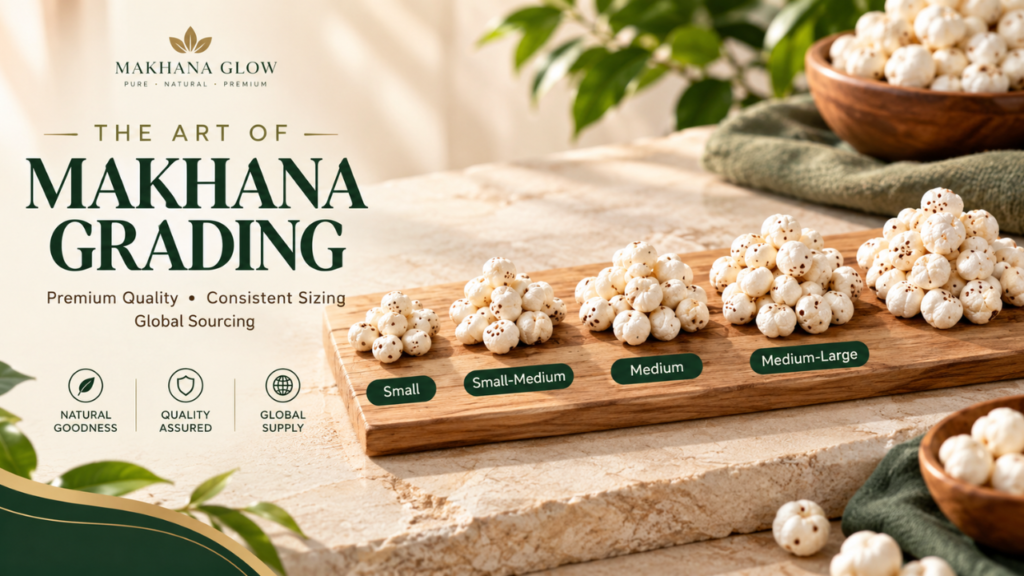
Grade decides how your pack looks and how your product is positioned. Larger, more uniform seeds usually suit premium and gifting packs, while mid-range grades often suit everyday snack packs. Smaller grades can suit cooking, powder or mixes.
| Brand plan | Grade considerations |
|---|---|
| Premium or gifting range | Larger grades, with strict attention to uniformity and whiteness |
| Everyday retail snack | Mid-range grades, chosen for consistent size and manageable cost |
| Cooking and fasting foods | Smaller to mid-range grades; consistency matters more than size |
| Mixes, powders and processing | Smaller grades; moisture and cleanliness matter most |
Sutta ranges vary between suppliers, so never order on the grade name alone. Confirm the size range in mm and the tolerance in writing. Our guide on [Internal Link: Makhana Grading Explained] shows exactly how to do that.
Step 3: Choose a Supplier and Lock the Specification
Your supplier becomes the backbone of your brand, so choose with care. Before you pay for packaging, agree the following in writing:
- Grade name, size range in mm and allowed tolerance
- Broken percentage and moisture limits
- Packing type, pack size and net weight
- Lead time and how batches are numbered
- What happens if a delivery differs from the approved sample
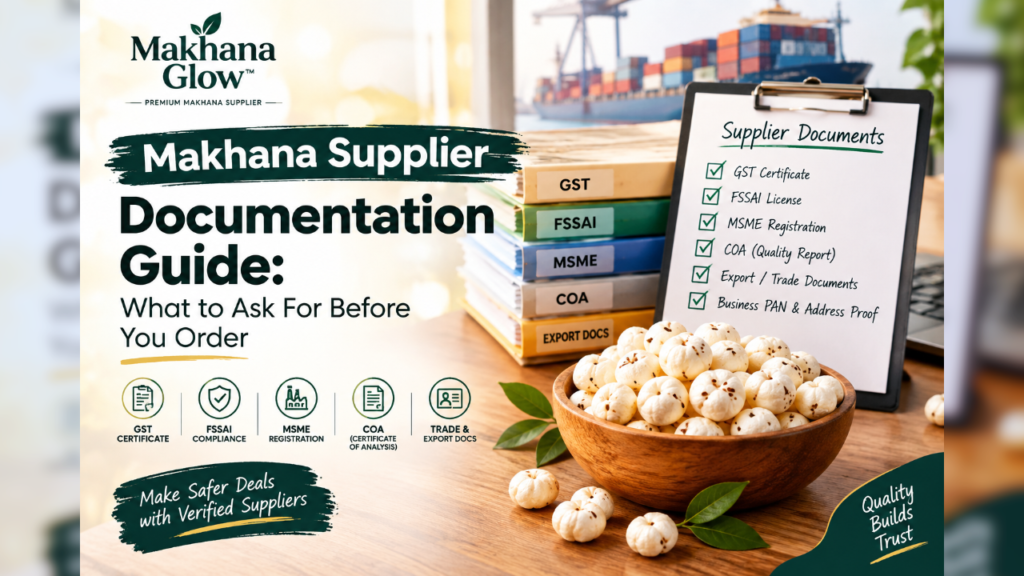
Then request a physical sample and keep it as your reference. When the bulk lot arrives, compare it against that sample before you pack anything. For the paperwork side, follow the checks in [Internal Link: Makhana Supplier Documents Guide].
Step 4: Design Packaging That Protects the Product
Makhana is light and crisp, and moisture reduces that crunch. As a result, packaging is more than decoration. Trade sources highlight moisture control as central to shelf life, so choose a pouch or pack with a suitable barrier and a reliable seal.
Consider these points:
- Pack format: stand-up pouches, jars or cartons each suit different channels.
- Pack size: small snack packs and larger family packs serve different buyers, so test with your target channel.
- Artwork approval: get a printed proof and sign it off before full production.
- Print runs: printed packaging often has its own minimum quantities, so plan them alongside your first order.
In addition, order a small sample pack run first. It lets you check fit, sealing and shelf appearance before you commit to a large print run.
Step 5: Get FSSAI Licensing and Labelling Right
Food labelling in India follows the FSSAI Labelling and Display Regulations, 2020, and the rules are specific. Confirm the current version with FSSAI or a qualified consultant before you print anything.
Which licence does a private label brand need?
A brand owner whose products are made by a third party generally needs its own FSSAI authorisation. Consultants commonly describe this as a “relabeller” kind of business on the FoSCoS portal, and the manufacturer must hold a valid FSSAI licence too. The correct category depends on your exact set-up, so check it on FoSCoS or with a food-licensing adviser.
What the label must show
According to the FSSAI regulations, the label carries the FSSAI logo and licence number of the brand owner. It also shows the licence number of the manufacturer, packer or marketer if that party differs from the brand owner. The brand owner’s name and address must appear with a qualifying phrase such as “Marketed by” or “Manufactured by”.
Beyond that, a typical pre-packaged food label also includes:
- Product name and ingredients list
- Net quantity
- Nutritional information
- Vegetarian logo, where applicable
- Batch or lot number
- Date marking such as best before
- Consumer care details
- MRP
Legal Metrology rules also apply to declarations like net quantity and price, so review both sets of rules with your adviser. In short, treat label compliance as a checklist to confirm, not something to assume.
Step 6: Protect Your Brand and Prepare for Retail
A brand needs protection before it grows. Search the trademark register for conflicts, then apply for trademark registration in the right class. A trademark attorney can advise on class selection for your product.
Retail chains and marketplaces often ask for a barcode. You can obtain barcodes through GS1 India, so plan this before you finalise the pack artwork. Marketplaces also usually require a valid FSSAI licence and a compliant label, which is another reason to settle licensing early.
Step 7: Work Out Your Costing
You can price your private label makhana sensibly only after you list every cost. Build a simple landed cost per pack from these blocks:
- Raw or graded makhana cost per kg
- Roasting or flavouring cost, if applicable
- Packaging and printing cost per pack
- Wastage and breakage allowance
- Freight and storage
- Licensing, testing and compliance costs
- Distributor and retailer margins, plus your own margin
Prices move with the season, so check current figures in [Internal Link: Makhana Price Per KG guide] before you finalise a number. Also avoid copying a competitor’s shelf price without knowing their cost structure, because their grade, pack and margins may differ from yours.
Step 8: Launch With a Trial Run
Start small, learn quickly and then scale. A sensible sequence looks like this:
- Approve a sample of your chosen grade.
- Run a small first batch with final packaging.
- Test the packs with a few retailers or online customers.
- Check shelf appearance and, where relevant, shelf-life performance.
- Place a larger repeat order once the product sells.
This path costs little and shows problems early. For example, you may discover that a pack size or grade does not suit your channel before you have invested in thousands of printed pouches.
Common Mistakes When Launching Private Label Makhana
- Ordering on the grade name alone. Without a written size range and tolerance, two lots of the same “grade” can look very different.
- Skipping the physical sample. Photos hide colour, breakage and moisture.
- Printing packaging too early. Artwork errors on a large print run are expensive.
- Ignoring licensing until the end. A missing licence can delay a launch or block marketplace listings.
- Comparing quotes without a common specification. A cheaper quote may cover a smaller grade or higher moisture.
- Launching too many products at once. One format and a few grades keep quality and cash flow under control.
Private Label Makhana Launch Checklist
- Product format chosen (raw, roasted or flavoured)
- Grade selected with size range in mm and tolerance agreed in writing
- Physical sample approved and kept as reference
- Supplier documents verified
- FSSAI licence category confirmed for your brand
- Packaging format and barrier chosen, and artwork proof signed off
- Label reviewed against FSSAI and Legal Metrology requirements
- Trademark search done and application filed
- Barcode arranged if your channel needs it
- Landed cost per pack calculated
- Small first batch planned before scaling
How Makhana Glow Supports Private Label Makhana Brands
Makhana Glow is a Sitamarhi, Bihar-based B2B supplier of graded makhana. Brand owners can start from small trial quantities of around 10 KG and scale to bulk volumes, and we do not apply a fixed 10-ton minimum. We supply multiple Sutta grades and HP grade, together with private-label and custom packaging on request, and we share GST, FSSAI, MSME and COA or quality documentation with serious buyers on request.
Every brand has different needs, so we discuss your requirement directly. Tell us your intended format, grade, pack size and target market. We will then confirm what we can support ourselves and where you may need a separate co-packer, for example for roasting or flavouring. A sample comes first, and you approve the quality before you place a bulk order.
Frequently Asked Questions
What is private label makhana?
Private label makhana is makhana that a supplier sources, grades and packs, and that you sell under your own brand name. You own the brand and the pack design, while the supplier handles the product.
What is the minimum order for private label makhana?
It depends on the supplier, the grade and the packaging. Some suppliers start with small trial quantities, while printed packaging may carry its own minimums. Ask for both figures in writing.
Do I need my own factory to start a makhana brand?
No. A private label model lets you launch without a plant, because a supplier or co-packer handles production. You still need the right licensing and a compliant label.
Do I need an FSSAI licence for private label makhana?
Generally yes. A brand owner selling third-party-made food usually needs its own FSSAI authorisation, and the manufacturer needs a valid licence as well. Confirm your exact category on FoSCoS or with a food-licensing adviser.
What is the difference between private label and OEM makhana?
Private label usually means a supplier’s standard product carries your brand. OEM usually means the product or pack is made to your own specification. Suppliers use both terms loosely, so ask what each includes.
Should I start with raw or roasted makhana?
Raw makhana is simpler because it needs only grading and packing. Roasted and flavoured makhana appeals to snackers but needs roasting, seasoning and shelf-life control. Many founders start with one format and expand later.
Which grade is best for a private label makhana brand?
There is no single best grade. Larger grades often suit premium packs, and mid-range grades often suit everyday snacks. Choose the grade that matches your product, market and budget, and confirm the size range in mm.
How long does it take to launch a private label makhana brand?
The timeline depends mainly on artwork approval, licensing and packaging lead times. Starting licensing and design early shortens the path.
Can I sell private label makhana on marketplaces?
Marketplaces usually ask for a valid FSSAI licence and a compliant label. Check the current rules of each platform before you list.
The safest way to launch private label makhana is to agree the specification and the samples before you print a single pouch.
Share your grade, pack size, target market and expected quantity with Makhana Glow, and we will confirm the specification and the next steps with you.