
Makhana Grading is one of the first things B2B buyers should understand before purchasing fox nuts in wholesale or bulk quantities. If a supplier quotes 3 Sutta, 4 Sutta, 4+ Sutta, 5 Sutta, 5+ Sutta, 6 Sutta or 6+ Sutta Makhana, the grade gives you a starting point for understanding size—but it does not describe the complete quality specification.
For wholesalers, distributors, food brands, private-label companies, retailers and importers, understanding Makhana Grading, Sutta size, quality and specifications can make bulk procurement much easier. The most important point is to confirm the actual size range, tolerance, quality parameters and sample before placing a large order.

What Is Makhana Grading?
Makhana grading is the process of sorting popped makhana into different commercial categories based mainly on physical characteristics such as size and uniformity.
However, Makhana Grading is not only about size.
Depending on the buyer’s application and supplier specification, a bulk lot may also be evaluated for:
- Size
- Size uniformity
- Broken pieces
- Flattened or irregular pieces
- Cleanliness
- Colour
- Moisture
- Foreign matter
- Puff or expansion characteristics
- Overall batch consistency
This distinction is important for B2B procurement.
A supplier may quote:
“5 Sutta Makhana – ₹___/kg”
But the grade name alone may not tell you:
- The exact diameter range
- Permitted size variation
- Broken percentage
- Moisture specification
- Packaging
- Sample quality
- Lot consistency
Therefore, a professional buyer should treat the Sutta grade as one part of the product specification, rather than the complete definition of quality.
ICAR has documented a popped-makhana grading machine that separates popped makhana into three diameter-based categories—approximately 12–15 mm, 15–19 mm and above 19 mm—and also separates flattened makhana. This demonstrates the practical importance of size-based grading in makhana processing.
ICAR Makhana Grading Technology

What Does Sutta Mean in Makhana Grading?
Sutta is a commercial trade term used to describe makhana size categories.
In general commercial usage, a higher Sutta number is associated with a larger size position.
For example:
4 Sutta → 5 Sutta → 6 Sutta
generally represents an increasing size position.
But there is an important point that every B2B buyer should know:
Sutta is not a universal millimetre conversion chart.
Different suppliers, processors and trading markets may use Sutta terminology with different size ranges and tolerances.
This means a buyer should not assume that every supplier’s:
5 Sutta = exactly the same millimetre range.
Instead, ask:
“What is the exact size range in millimetres for this Sutta grade?”
This simple question can prevent misunderstandings when comparing multiple suppliers.
APEDA’s Farmer Connect portal also shows current commercial buyer enquiries using terminology such as “6 suta / premium makhana,” demonstrating that Sutta terminology is actively used in commercial procurement.
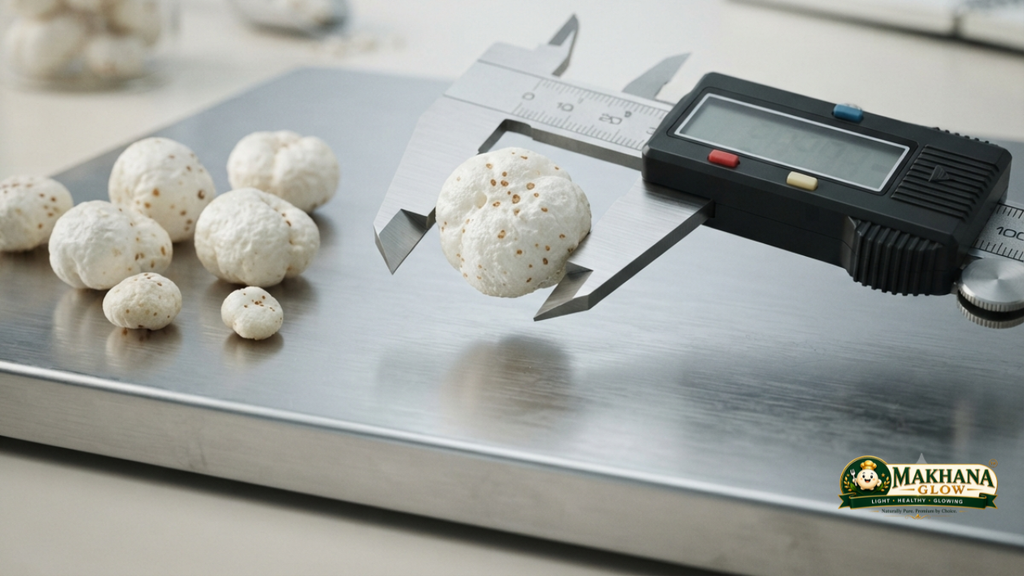
Makhana Sutta Size vs Millimetres
Buyers sometimes try to convert Sutta directly into millimetres.
A simple mathematical relationship may be used as a general reference, but commercial Makhana Grading should not be based only on a mathematical Sutta conversion.
Why?
Because commercial grading depends on the actual sorting specification being used by the supplier.
For example, ICAR’s documented grading machine uses diameter categories of:
| Documented diameter category | Approximate size |
|---|---|
| Grade 1 | 12–15 mm |
| Grade 2 | 15–19 mm |
| Grade 3 | Above 19 mm |
ICAR also notes separation of flattened makhana.
These technical categories are not a universal conversion table for 3, 4, 5 or 6 Sutta.
Instead, they demonstrate why serious B2B buyers should request the actual millimetre specification from their supplier.
What Should a Buyer Ask?
Instead of asking only:
“What Sutta is this?”
ask:
“What Sutta grade is this, what is the actual diameter range in mm, and what tolerance is allowed?”
That gives you a much clearer procurement specification.
Complete Makhana Grade Guide
The following table is a commercial buyer reference, not a mandatory universal grading standard.
| Makhana Grade | General Size Position | Potential Applications | What to Confirm |
|---|---|---|---|
| 3 Sutta | Smaller selection | Processing, mixes, selected snack applications | Actual mm range, breakage |
| 4 Sutta | Medium selection | Roasting, wholesale, food processing | Size and uniformity |
| 4+ Sutta | Above standard 4 selection | Retail and snack applications | Exact meaning of “+” |
| 5 Sutta | Medium-large selection | Retail, roasting, snack brands | Size, tolerance, breakage |
| 5+ Sutta | Above standard 5 selection | Presentation-focused products | Exact specification |
| 6 Sutta | Large selection | Retail, premium-positioned products | Size, colour, uniformity |
| 6+ Sutta | Above standard 6 selection | Larger-size requirements | Exact mm range |
| HP Grade | Supplier/market-specific | Application-dependent | Exact HP definition |
Important: The exact meaning of 4+, 5+, 6+ and HP should always be confirmed with the supplier.
3 Sutta Makhana: Size and Applications
3 Sutta generally represents a smaller commercial size selection.
A smaller grade does not automatically mean poor quality.
The suitability of a grade depends on the buyer’s application.
For example, smaller makhana may be considered for:
- Food processing
- Ingredient blends
- Grinding
- Selected snack applications
- Commercial formulations
For these applications, a buyer may care more about:
Cleanliness + consistency + processing suitability
than simply selecting the largest possible pieces.
Before purchasing 3 Sutta in bulk, confirm:
- Actual size range
- Broken percentage
- Cleanliness
- Moisture specification
- Sample quality
The right question is not:
“Is 3 Sutta good?”
The better question is:
“Is this 3 Sutta specification suitable for my product?”

4 Sutta Makhana: Buyer Guide
4 Sutta generally represents a medium commercial size selection.
It may be considered for:
- Roasting
- Flavouring
- Wholesale
- Food processing
- Retail products
- Snack manufacturing
For processing applications, size consistency can be particularly important.
If a batch contains very different sizes, individual pieces may behave differently during roasting or coating.
Therefore, ask the supplier:
- What is the actual size range?
- What tolerance is allowed?
- What is the broken percentage?
- How uniform is the batch?
- Can I receive a physical sample?
What Is 4+ Sutta Makhana?
4+ Sutta generally refers to a selected size positioned above a standard 4 Sutta specification.
However, the exact definition of 4+ can vary between suppliers.
For one supplier, 4+ may represent a particular size range. Another supplier may use different tolerances.
Therefore, do not purchase only on the label.
Ask:
“What exact millimetre range do you define as 4+ Sutta?”
Also confirm:
- Minimum size
- Maximum size
- Allowed tolerance
- Broken percentage
- Sample
- Packaging
For repeat B2B purchases, keep the approved sample and written specification as your procurement reference.
5 Sutta Makhana: Size and Applications
5 Sutta generally represents a medium-to-large commercial size selection.
It can be considered for:
- Roasted makhana
- Flavoured makhana
- Retail packs
- Snack brands
- Wholesale distribution
- Private-label products
For consumer-facing products, appearance can become an important consideration.
Customers often judge a packaged snack partly by its visual appearance.
Therefore, a buyer should evaluate:
Size + uniformity + colour + breakage + cleanliness + puff quality
rather than looking at the Sutta number alone.
If you are developing a private-label product, keep an approved reference sample for future purchase cycles.

What Is 5+ Sutta Makhana?
5+ generally indicates a selected range positioned above standard 5 Sutta.
The exact specification is supplier-dependent.
For example, two suppliers may both quote:
5+ Sutta
but provide different size distributions.
Therefore, when requesting a quotation, specify:
- Grade
- Actual mm range
- Tolerance
- Broken percentage
- Quantity
- Packaging
- Delivery destination
This turns a general product enquiry into a clear B2B purchasing requirement.
6 Sutta Makhana: Larger Makhana Grade
6 Sutta generally represents a larger commercial size selection.
Larger pieces may be considered when visual presentation is an important part of the product.
Potential applications include:
- Premium-positioned retail
- Gifting formats
- Presentation-focused snack products
- Selected private-label products
But remember:
6 Sutta does not automatically mean better overall quality.
A large makhana lot may still have:
- Broken pieces
- Mixed sizes
- Colour variation
- Moisture issues
- Poor cleanliness
- Inconsistent quality
Therefore, always inspect the complete sample.
What Is 6+ Sutta Makhana?
6+ generally refers to a selected range positioned above standard 6 Sutta.
However, the exact meaning depends on the supplier’s commercial specification.
Some buyers and sellers may also encounter terminology for larger selections, but there is no reason to assume that every market participant uses exactly the same definitions.
If you require 6+ Sutta, request:
Exact mm range + tolerance + sample + quality specification
before confirming a bulk order.
APEDA’s Farmer Connect portal currently shows a buyer enquiry for 10 MT of “6 suta / premium makhana,” illustrating that this terminology is used in real B2B procurement.
HP Grade Makhana Explained
HP Grade needs special attention because HP is not a universally defined Sutta grade.
Some suppliers may use HP in connection with puff or expansion characteristics, while others may use HP as a commercial designation.
Therefore, never assume that:
HP = one universally fixed specification.
If a supplier quotes HP Grade, ask:
- What does HP mean in your specification?
- What is the size range?
- What is the puff or expansion criterion, if applicable?
- What is the broken percentage?
- What is the moisture specification?
- How does HP differ from your standard Sutta grades?
- Can you provide a sample?
For B2B procurement, the written specification should always take priority over an unexplained abbreviation.

Does Bigger Makhana Mean Better Quality?
No. Bigger size does not automatically mean better overall quality.
This is one of the most important principles in Makhana Grading.
Sutta primarily helps communicate size positioning.
Overall quality can involve:
- Size
- Uniformity
- Cleanliness
- Broken percentage
- Moisture
- Colour
- Foreign matter
- Puff or expansion
- Storage condition
- Batch consistency
For example, a supplier may offer a large-sized lot, but if the lot has significant breakage or inconsistent sizing, it may not be suitable for a premium retail product.
Another lot may have slightly smaller pieces but better uniformity and processing suitability.
The correct choice depends on:
Your product + customer + processing method + target price + required specification
Makhana Grade vs Makhana Quality
These two terms should not be confused.
Makhana Grade
Usually communicates a commercial size category.
Makhana Quality
Refers to a wider set of characteristics.
A professional buyer should therefore compare suppliers using:
Grade + Size + Tolerance + Quality + Sample + Packaging + Commercial Terms
rather than:
Grade + Price
This is particularly important when comparing quotations from different suppliers.

How Makhana Is Sorted and Graded
A simplified post-harvest journey can be represented as:
Harvesting → Cleaning → Processing/Popping → Sorting → Grading → Quality Inspection → Packing → Dispatch
Actual processing systems can vary.
ICAR has documented mechanised makhana processing technologies as well as a dedicated popped-makhana grading machine. Its grading machine uses diameter-based separation and separates flattened makhana.
The important point for a B2B buyer is not simply the equipment used.
The important question is:
Can the supplier consistently deliver the agreed specification?
For repeat procurement, consistency can be more useful than simply choosing the largest-looking grade.
Why Makhana Grading Matters for B2B Buyers
Retail Appearance
A more uniform size distribution can help create a consistent visual presentation.
Roasting
Different sizes may respond differently during processing.
Flavour Coating
More consistent pieces can make processing easier to control.
Packaging
Size and appearance influence the visual presentation of the finished retail pack.
Private Label
A brand needs a repeatable product specification across purchase cycles.
Wholesale
A clear specification makes supplier comparison easier.
Export
International buyers may request clearly documented product specifications, packaging and other commercial requirements.
APEDA’s recent market research highlights the scale and export opportunity of India’s makhana sector, while current APEDA trade listings show Indian suppliers offering makhana in different commercial sizes and forms.
[External Link: APEDA Makhana Study Report]
Which Makhana Grade Should You Choose?
There is no single grade that is automatically suitable for every business.
Your choice should depend on the end application.
| Application | Main Factors to Consider |
|---|---|
| Retail snack | Appearance, size, consistency |
| Premium retail | Size, presentation, uniformity |
| Gifting | Visual appearance and consistency |
| Private label | Approved sample and repeatability |
| Roasted/flavoured products | Size uniformity and processing |
| Food manufacturing | Functional processing requirements |
| Grinding | Processing suitability and cleanliness |
| Bulk wholesale | Specification, quantity and price |
| Institutional supply | Application and consistency |
| Export | Buyer specification, documentation and destination requirements |
The best procurement decision starts with:
“What does my product require?”
not:
“Which Sutta is the biggest?”
15 Questions to Ask a Makhana Supplier
Before confirming a wholesale or bulk order, ask:
- What exact Sutta grade are you supplying?
- What is the actual size range in mm?
- What tolerance is allowed?
- What is the broken percentage?
- What is the moisture specification?
- How is the product sorted?
- How uniform is the lot?
- Can you provide a physical sample?
- Is relevant quality documentation available?
- What packaging options are available?
- What is the MOQ?
- What is the expected lead time?
- What is the product source/origin?
- What happens if the delivered product differs from the agreed specification?
- Can you support private-label or OEM requirements?
Save This Checklist Before Buying
Grade → mm → tolerance → quality → sample → packaging → quantity → delivery
This is a much stronger procurement process than comparing only price per kilogram.
Common Makhana Buying Mistakes
1. Buying Only on Price
The lowest ₹/kg quotation may not represent the same product specification.
Compare like-for-like specifications.
2. Assuming Higher Sutta Means Better Quality
Higher Sutta generally indicates a larger size position, not automatically better overall quality.
3. Buying Without a Sample
A sample allows the buyer to evaluate the actual product before committing to a larger quantity.
4. Not Defining Size Tolerance
“5 Sutta” may not be enough for a buyer requiring a controlled size range.
5. Ignoring Broken Percentage
Breakage can influence retail appearance and usable product quantity.
6. Ignoring Moisture
Ask the supplier for the relevant moisture specification and documentation where applicable.
7. Not Keeping the Approved Sample
For repeat orders, the approved sample can become an important reference.
8. Not Defining the “+” Grade
Always ask what 4+, 5+ or 6+ means in the supplier’s specification.
9. Assuming HP Has One Universal Meaning
Ask the supplier to define HP in writing.
Makhana Bulk Buying Checklist
Before placing your order:
☐ Confirm exact Sutta grade
☐ Confirm actual mm range
☐ Confirm tolerance
☐ Ask broken percentage
☐ Ask moisture specification
☐ Request physical sample
☐ Check cleanliness
☐ Check colour
☐ Check size uniformity
☐ Confirm packaging
☐ Confirm MOQ
☐ Confirm lead time
☐ Confirm relevant documentation
☐ Agree on delivered-quality specification
☐ Confirm OEM/private-label requirements if applicable
Makhana Wholesale and Bulk Supply
If you are sourcing makhana for wholesale, food manufacturing, retail or private-label production, the first step should be defining your actual requirement.
Makhana Glow focuses on B2B requirements for buyers looking for:
- Wholesale makhana
- Bulk makhana
- Different commercial grades
- Private-label requirements
- OEM opportunities
- Sample-based evaluation
- Business-to-business supply
The goal should not be to push one particular grade.
The goal is to understand the buyer’s:
Application → Grade → Quantity → Specification → Packaging → Destination
and then discuss the appropriate supply requirement.
Why Buy Makhana From a B2B Supplier?
For a serious buyer, supplier selection is about more than finding a price.
A B2B supplier should be able to discuss:
Product Specification
What exact grade and size does the buyer require?
Quantity
Is the requirement for 10 kg, 100 kg, 500 kg, 1 MT or more?
Packaging
Does the buyer require bulk bags, customised packaging or private-label packaging?
Sampling
Can the buyer evaluate the product before a larger commitment?
Repeat Supply
Can the agreed product specification be used as a reference for future orders?
Business Requirements
Can the supplier support wholesale, distribution, food brands, private label or export-oriented requirements?
These questions create a much stronger foundation for a long-term B2B supply relationship.

Building Your Own Makhana Brand?
If you are a food brand, retailer or entrepreneur planning to launch your own makhana product, the requirement can be more detailed.
You may need to decide:
- Product grade
- Size
- Plain or flavoured product
- Pack size
- Packaging format
- Branding
- Label requirements
- Quantity
- Target market
- Distribution model
For private-label projects, it is particularly useful to approve the product specification and sample before production or bulk procurement.
Makhana Sample Before Bulk Order
For a new B2B buyer, a sample can help answer questions that a product description cannot.
A physical sample can help you evaluate:
- Size
- Uniformity
- Appearance
- Breakage
- Cleanliness
- Processing suitability
- Overall product expectation
The sample should then be compared with the final bulk shipment against the agreed specification.
Frequently Asked Questions About Makhana Grading
What Is Makhana Grading?
Makhana Grading is the commercial process of sorting popped makhana according to size and other physical characteristics. Exact commercial specifications may vary by supplier.
What Is Sutta in Makhana?
Sutta is a trade term used to describe makhana size categories. Generally, higher Sutta numbers indicate a larger size position, but exact commercial specifications can vary.
What Does 3 Sutta Makhana Mean?
3 Sutta generally refers to a smaller commercial size selection. Confirm the supplier’s actual millimetre range before purchasing.
What Does 4 Sutta Makhana Mean?
4 Sutta generally represents a medium-size commercial selection. The exact specification should be confirmed with the supplier.
What Is 4+ Sutta Makhana?
4+ generally refers to a selected size above standard 4 Sutta. The exact definition and tolerance should be confirmed with the supplier.
What Is 5 Sutta Makhana?
5 Sutta generally represents a medium-to-large commercial size position and can be considered for retail, roasting and snack applications.
What Is 5+ Sutta Makhana?
5+ generally refers to a selected range above standard 5 Sutta. Exact size and tolerance may vary.
What Does 6 Sutta Makhana Mean?
6 Sutta generally represents a larger commercial size selection. Buyers should confirm the actual size range.
What Is 6+ Sutta Makhana?
6+ generally represents a selected range above standard 6 Sutta. Confirm the exact specification before ordering.
What Is HP Grade Makhana?
HP is not a universally fixed Sutta grade. Its meaning may vary by supplier, so buyers should request the exact definition and specification.
Is Higher Sutta Always Better?
No. Higher Sutta generally indicates larger size, but overall quality also depends on factors such as uniformity, cleanliness, breakage, moisture, colour and other specifications.
How Do I Choose the Right Makhana Grade?
Start with your application. Consider the product you are making, customer expectations, required appearance, processing method, quantity and target commercial specification.
What Should I Check Before Buying Makhana in Bulk?
Confirm:
Grade + actual mm range + tolerance + broken percentage + moisture specification + sample + packaging + quantity + delivery terms.
Can I Buy Makhana for Private Label?
Yes, private-label buyers can discuss product grade, quantity, packaging and branding requirements with a suitable B2B supplier.
About Makhana Glow
Makhana Glow Private Limited is focused on B2B makhana requirements from Bihar, serving buyers who are looking for wholesale, bulk and private-label opportunities.
Based in Sitamarhi, Bihar, the business is positioned around B2B supply requirements rather than only retail sales.
For buyers, the process starts with understanding:
What product do you need?
What grade do you need?
How much do you need?
Where does it need to go?
What packaging do you require?
From there, the appropriate specification can be discussed.
Need Help Choosing the Right Makhana Grade?
You do not have to decide your requirement based only on a Sutta number.
If you are unsure whether you need 3 Sutta, 4 Sutta, 4+ Sutta, 5 Sutta, 5+ Sutta, 6 Sutta, 6+ Sutta or another specification, share your:
- Product/application
- Required quantity
- Target market
- Packaging requirement
- Destination
- Preferred grade, if known
The requirement can then be discussed before you commit to a bulk order.
Ready to Discuss Your Requirement?
Final Takeaway: Don’t Buy the Number. Buy the Specification.
The easiest way to understand Makhana Grading is to remember:
Sutta helps describe size. Quality describes much more.
A 3 Sutta, 4 Sutta, 5 Sutta or 6 Sutta label can help start a procurement conversation, but a serious B2B buyer should go further.
Before purchasing, confirm:
Grade → Actual Size → Tolerance → Quality → Sample → Packaging → Quantity → Delivery
And whenever you see:
4+ / 5+ / 6+ / HP
ask the supplier to explain the exact specification.
This approach helps wholesalers, distributors, food brands, retailers, private-label companies and importers compare products more accurately and reduce misunderstandings during bulk procurement.
If you are planning a wholesale or bulk makhana purchase, start by defining your product requirement—not simply by choosing the largest Sutta.

Pingback: Makhana Price Per KG: 2026 Wholesale Rate and Buying Guide