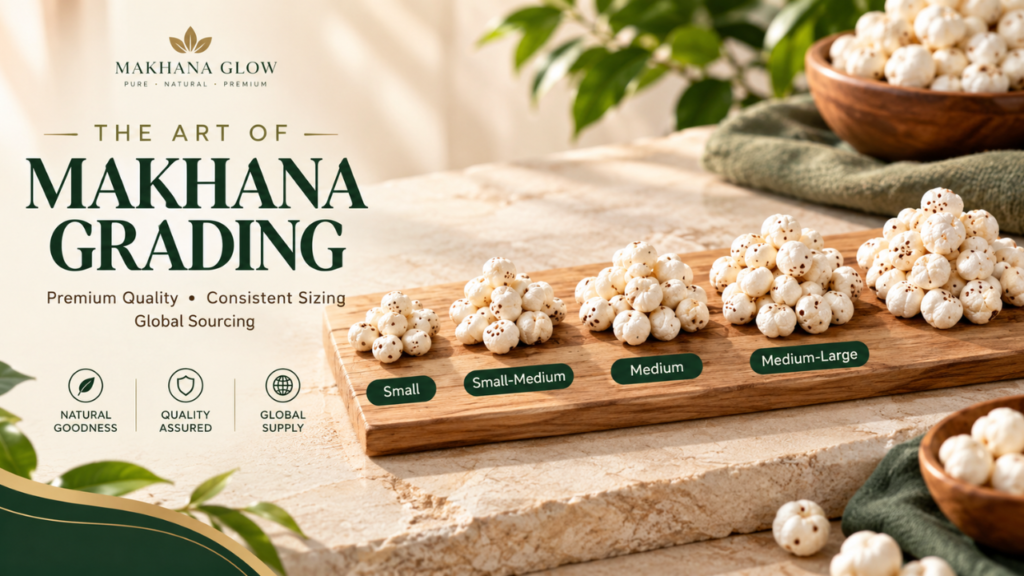
The makhana price per kg in India has climbed a long way in five years, and the number you see depends on who is quoting it. Mandi data reported through Agmarknet averaged about ₹776 per kg at wholesale in early August 2026. Exporter guides, on the other hand, quote anything from roughly ₹350 to ₹1,780 per kg, depending on grade and season. Both can be right, because they describe different products.
This guide explains why the numbers differ. You will see what the makhana price per kg looks like at wholesale and retail, what pushes it up or down, how 1 kg and 250 gm prices relate, and where Bihar fits in. In addition, you will learn how to compare quotes from marketplaces and direct suppliers without being misled. Along the way, it answers the questions people search most: which plant makhana comes from, what it is called in English, and how much 1 kg really is.
If you are buying a few packets for home, the retail price is simply the pack price on the shelf. This guide is written for buyers who purchase in volume: wholesalers, distributors, retailers, brands and importers.
6. Quick Answer: Makhana Price Per KG in 2026
In fact, there is no single national rate. Here is what recent published sources report, so you can see the spread for yourself.
| Source type | Reported range (per kg) | What it likely covers |
|---|---|---|
| Government mandi data via Agmarknet (aggregated by ACROP, early Aug 2026) | Average about ₹776 | Average of 10 mandis in one state, so not a national picture |
| Exporter guide to Bihar wholesale rates (mid-2026) | ₹600–₹1,250 | Standard 4–5 Suta grades |
| Same guide | About ₹1,100–₹1,780 | Premium 6+ Suta export grades |
| Same guide | ₹300–₹500 | Broken or commercial grades for processing |
| Another 2026 trade guide | ₹350–₹950 | Wholesale, varies with size and whiteness |
| Other 2026 trade guides | ₹700–₹1,700 | Good-quality lots, varies with grade and stock |
How to read this table. However, none of these figures is a quote. They come from different dates, different grades and different sources, which is exactly why they disagree. Use them for orientation, then ask any supplier for a written price on your specific grade, quantity and packing.
Two patterns hold across almost every source. First, the makhana price per kg rises with size, whiteness and sorting quality. Second, it is usually lowest around harvest and highest in the off-season.
7. Makhana Price Per KG, 1 KG and 250 GM: How They Relate
Many searches ask “1 kg makhana kitna hota hai” or “makhana 250 gm price”. The two questions have simple answers once you separate weight from price.
How much is 1 kg of makhana?
To begin with, one kilogram is a weight, not a piece count. The number of pieces in 1 kg depends on the grade. A larger Sutta grade has bigger seeds, so 1 kg holds fewer pieces. Conversely, a smaller grade holds more. Popped makhana is also very light, so 1 kg fills a surprisingly large volume. For that reason, professional buyers order by weight and grade, never by piece count or volume.
What is the 250 gm price?
As simple arithmetic, 250 gm is one quarter of a kilogram. For illustration, if a grade cost ₹800 per kg, 250 gm of it would cost ₹200 before packing. In reality, the 250 gm retail pack costs more per kg than the bulk rate, because it carries packaging, labelling, brand margin, transport and shelf space. That is why the same makhana can look very different in price between a mandi bag and a supermarket pack.
Wholesale versus retail: where the difference comes from
- Packaging: small consumer packs cost more per kg to produce than bulk sacks.
- Handling layers: each distributor or retailer adds a margin.
- Volume: bulk orders usually earn a lower per-kg rate. Container-scale buyers often negotiate the lowest rates of all.
- Presentation: premium retail packs usually use the larger, whiter grades.
8. What Decides the Makhana Price Per KG
In practice, ten factors explain most of the gap between one quote and another. Compare them before you compare rates.
Grade or Sutta size
Generally, larger, more uniform seeds command higher prices, while smaller or broken grades sell for less. Sutta ranges vary between suppliers, so confirm the actual size range in mm before you compare. Our guide on [Internal Link: Makhana Grading Explained] shows how to do that.
Whiteness and popping quality
Seeds that pop fully and stay bright white look better on a shelf, so buyers pay more for them.
Broken percentage and cleanliness
A cheap quote often hides more broken pieces or foreign matter. Therefore, ask for the broken percentage in writing.
Moisture
Makhana sold at higher moisture weighs more per kg, and it can also lose crunch and shelf life. One trade report notes that the National Makhana Board recommends a maximum moisture level for wholesale trade. Treat that as a claim to verify. Instead, ask each supplier for their moisture specification.
Hand-picked versus machine-sorted
Hand selection is slow and labour-intensive. As a result, hand-picked premium lots cost more than machine-sorted commercial lots.
Season and stock
Harvest in Bihar runs roughly from July to September, according to trade reports. Fresh arrivals usually push prices down at that time. As stock thins, rates typically climb and often peak in February and March. Trade sources describe swings of ₹100–₹300 per kg between the harvest and off-season windows, so timing a large purchase matters.
Origin and transport
First, buying close to the growing belt cuts interstate freight and handling. By contrast, prices in other states usually add those costs.
Packing and net weight
Sacks, vacuum packs and custom private-label packing all cost different amounts. Therefore, always compare the same packing.
Quantity and payment terms
Larger volumes earn better rates, and advance payment or long credit changes the rate as well.
Crop year and demand
Weather affects yield, and meanwhile demand from health-conscious consumers keeps the market firm. Consequently, the price you saw last year is only a rough guide.
9. Why Makhana Costs More Than Most Dry Snacks: From Pond to Pack
Makhana is not cheap to produce, so the process explains a good part of the price.
Which plant is makhana made from?
The seeds come from Euryale ferox, a freshwater aquatic plant called the prickly water lily. It grows in still, shallow water such as ponds, oxbow lakes and wetlands. Its round, spiny leaves can spread more than a metre across. The raw seeds have a dark outer shell, which is why makhana is sometimes called the “Black Diamond”.
Makhana in English
In English, the most common names are fox nut and gorgon nut. In trade, you will also see it sold as lotus seeds or phool makhana. The lotus label is a market habit: botanically, the plant is a water lily, not the sacred lotus. Popped makhana is also known locally as lava.
How makhana is produced
Growers harvest the seeds by hand from the pond bottom. They then dry and roast the seeds, and pop them to produce the white, light makhana that buyers recognise. One trade analysis estimates that about 100 kg of raw seed yields only 35–40 kg of popped makhana. Treat that as an approximate figure, because yields vary by crop and process. Even so, the direction is clear: heavy manual work and a modest yield keep the cost of makhana high.
10. Why Bihar Sets the Pace for Makhana Prices
Bihar is the centre of makhana production. In fact, sources cite its share between roughly 80% and 90% of India’s output, with the higher figure most common. Growing is concentrated in the Mithilanchal region, which includes districts such as Darbhanga, Madhubani, Purnea, Katihar and Sitamarhi.
Three developments matter for buyers:
- GI tag: “Mithila Makhana” received a Geographical Indication tag in 2022, which strengthens its identity as a regional product.
- National Makhana Board: the government announced a Makhana Board in the Union Budget 2025-26, and reports say it was inaugurated in Purnea in September 2025. Its stated goals include better production, processing and marketing.
- Processing outside Bihar: several reports note that much of the raw material moves to processing units in other states, which then add value through flavouring and packing.
For a B2B buyer, this has a practical meaning. Sourcing nearer the origin usually removes a layer or two of intermediaries, which can lower the makhana price per kg you pay. However, proximity alone does not guarantee quality, so the checks in the next section still apply.
11. Where to Buy Makhana in Bulk: Mandi, Marketplace or Direct Supplier
Many buyers begin their search on marketplaces such as IndiaMART. That is a reasonable starting point, provided you compare listings carefully.
| Channel | Works well for | Watch out for |
|---|---|---|
| Local mandi or trader | Quick spot buying, price discovery | Mixed grades, limited documentation |
| B2B marketplace listings | Finding many suppliers fast | “Price on request” teasers, unclear grade definitions, very low minimums that hide the real rate |
| Direct graded supplier | Repeat orders, specification control, documents | Needs a sample and written specification before you commit |
Whichever channel you use, compare like with like. A makhana price per kg comparison only makes sense when grade and moisture match. For instance, a ₹700 quote for a small grade with high moisture is not cheaper than a ₹900 quote for a uniform, low-moisture grade. Our guide on [Internal Link: Makhana Supplier Documents Guide] lists the documents to request before you pay.
12. How to Compare Two Makhana Price Per KG Quotes
Use this checklist so both quotes describe the same thing:
- The same grade name and the same size range in mm
- Matching moisture and broken percentage limits
- Identical packing type and net weight per bag
- A common price basis, for example ex-warehouse or delivered to your city
- GST included or extra
- Equal payment terms and lead time
- A physical sample from the same lot you will receive
If a supplier will not confirm these points in writing, the quote is not ready to compare.
13. Why Demand Keeps the Price Firm
Over the years, makhana has moved from a fasting-season food to an everyday snack ingredient. Government and educational sources describe it as low in fat, mostly carbohydrate, and a source of protein. That profile suits health-focused snacking, which is one reason demand has grown. This is general food information and not medical advice.
Buyers use makhana in several ways:
- Roasted and flavoured snacks
- Traditional dishes such as kheer
- Namkeen and dry-fruit mixes
- Powder and flour for fasting foods
- Private-label snack ranges
Because these segments need different grades, the makhana price per kg for each segment differs too.
14. How Makhana Glow Quotes a Price
Makhana Glow is a Sitamarhi, Bihar-based B2B supplier of graded makhana. Our supply runs from small trial quantities of around 10 KG up to 10+ tons, and there is no fixed minimum order of 10 tons. Buyers can choose from multiple Sutta grades and HP grade, with private-label and custom packing on request. In addition, serious buyers can request GST invoicing, FSSAI, MSME registration and COA or quality documentation.
However, we do not publish a fixed rate on the website, because the rate depends on the grade, quantity, packing, destination and the day you ask. Instead, we quote against your specification. To get an accurate makhana price per kg, send us:
- Required grade or size range
- Quantity and how often you buy
- Packing preference, including any private-label needs
- Delivery location
You can also request a sample first and approve the quality before you commit to a bulk order.
[Internal Link: Wholesale Quote — https://makhanaglow.com/wholesale-quote/]
15. Frequently Asked Questions
What is the makhana price per kg today?
It depends on grade, season and quantity. Overall, recent published sources put wholesale rates anywhere from about ₹350 to ₹1,780 per kg in mid-2026, and mandi data averaged about ₹776 in early August. For an exact figure, ask a supplier for a written quote on your grade.
How much is 1 kg of makhana?
One kilogram is a fixed weight, but the piece count varies by grade because larger seeds mean fewer pieces per kilogram. Price also varies, so ask for the per-kg rate for a specific grade.
What is the price of makhana 250 gm?
Divide the per-kg rate by four for the raw product value, then add packing, brand and retail margin. Retail packs cost more per kg than bulk sacks.
Which plant is makhana made from?
Makhana comes from the seeds of Euryale ferox, also called the prickly water lily or fox nut plant. It grows in ponds and wetlands.
What is makhana called in English?
The common English names are fox nut and gorgon nut. It is also sold as lotus seeds or phool makhana, although the plant is a water lily rather than a lotus.
Why is makhana so expensive?
Harvesting, drying, roasting and popping involve heavy manual work, and the yield of popped makhana from raw seed is modest. In addition, seasonal supply and rising demand add to the cost.
When is the best time to buy makhana in bulk?
Trade reports suggest harvest months, roughly July to September in Bihar, offer the lowest prices, while February and March are often the peak. Storage and cash-flow limits decide how much you can buy early.
Is Bihar makhana cheaper?
Bihar is the main growing region, so buying near the source often removes transport and intermediary costs. Quality still depends on grading, moisture and sorting, so verify a sample.
Is a marketplace price the real price?
Not always. For example, listings can show a low starting rate or “price on request”. Therefore, confirm grade, moisture, packing and price basis before you treat any listing as a quote.
What are the benefits of eating makhana?
Makhana is generally described as low in fat and a source of carbohydrate and protein. For personal health advice, speak to a qualified doctor or dietitian.
हिंदी में जवाब (Hindi FAQ)
1 किलो मखाना कितना होता है? 1 किलो वजन की इकाई है। इसमें कितने दाने आएंगे, यह ग्रेड पर निर्भर करता है, क्योंकि बड़े सुट्टा के दाने कम आते हैं और छोटे ग्रेड के ज्यादा। थोक में हमेशा वजन और ग्रेड बताकर ऑर्डर करें।
मखाना का थोक भाव क्या है? थोक भाव ग्रेड, सीजन, मात्रा और पैकिंग के हिसाब से बदलता रहता है। सटीक भाव के लिए अपने ग्रेड और मात्रा के साथ सप्लायर से लिखित कोटेशन मांगें।
मखाना किस पौधे से बनता है? मखाना यूरेल फेरॉक्स (कांटेदार जल-कमल / कमल-जाति का जलीय पौधा) के बीजों से बनता है, जो तालाबों और जलाशयों में उगता है।
Internal Link Suggestions
- Wholesale Quote
- Sample Request
- Bulk Makhana
- Quality & Processing
- Packaging
- OEM / Private Label
- Export / International Buyers
- 6 Sutta Makhana
- FAQ
- Makhana Grading Explained
- Makhana Supplier Documents Guide
Sources & References
- Agmarknet (data.gov.in) mandi price data, as aggregated and reported by ACROP (early August 2026 average).
- Union Budget 2025-26 announcement of a Makhana Board in Bihar, and reports on its inauguration in Purnea in September 2025 (current-affairs summaries such as current-affairs/national-makhana-board/).
- GI Registry: “Mithila Makhana” Geographical Indication (2022), as reported in government-linked and educational summaries.
- Exporter and trade guides on 2026 Bihar wholesale rates and seasonality used only to cross-check price ranges and seasonal patterns. They are commercial sources, so treat their figures as indicative.
Note: Prices, thresholds and regulations change. The figures in this article describe what published sources reported in mid-2026 and are not a quote from Makhana Glow. Always confirm the current rate directly with a supplier.
The fastest way to learn the real makhana price per kg for your business is to share your specification. Send us your grade, quantity, packing and delivery location, and we will quote against it after you approve a sample.